Beyond Text-to-SQL: Implementing OpenAI’s 6-Layer Context Data Agent and the Hidden Challenges


1 Introduction
Data is the core driving force behind modern corporate decision-making and product iteration. However, as organizations scale, the biggest challenge is no longer “how to store data,” but “how humans can understand massive, chaotic datasets.”
A technical blog post published by the OpenAI team, “Inside our in-house data agent”, offers a rare look at how this leading AI laboratory solves its own data pain points.
OpenAI has over 3,500 internal users across engineering, product, research, and finance departments, sitting on a massive pool of 70,000 datasets totaling over 600 PB. At this scale, analysts spent a significant amount of time just “finding the right tables” and “deciphering the hidden business logic inside historical SQL queries.”
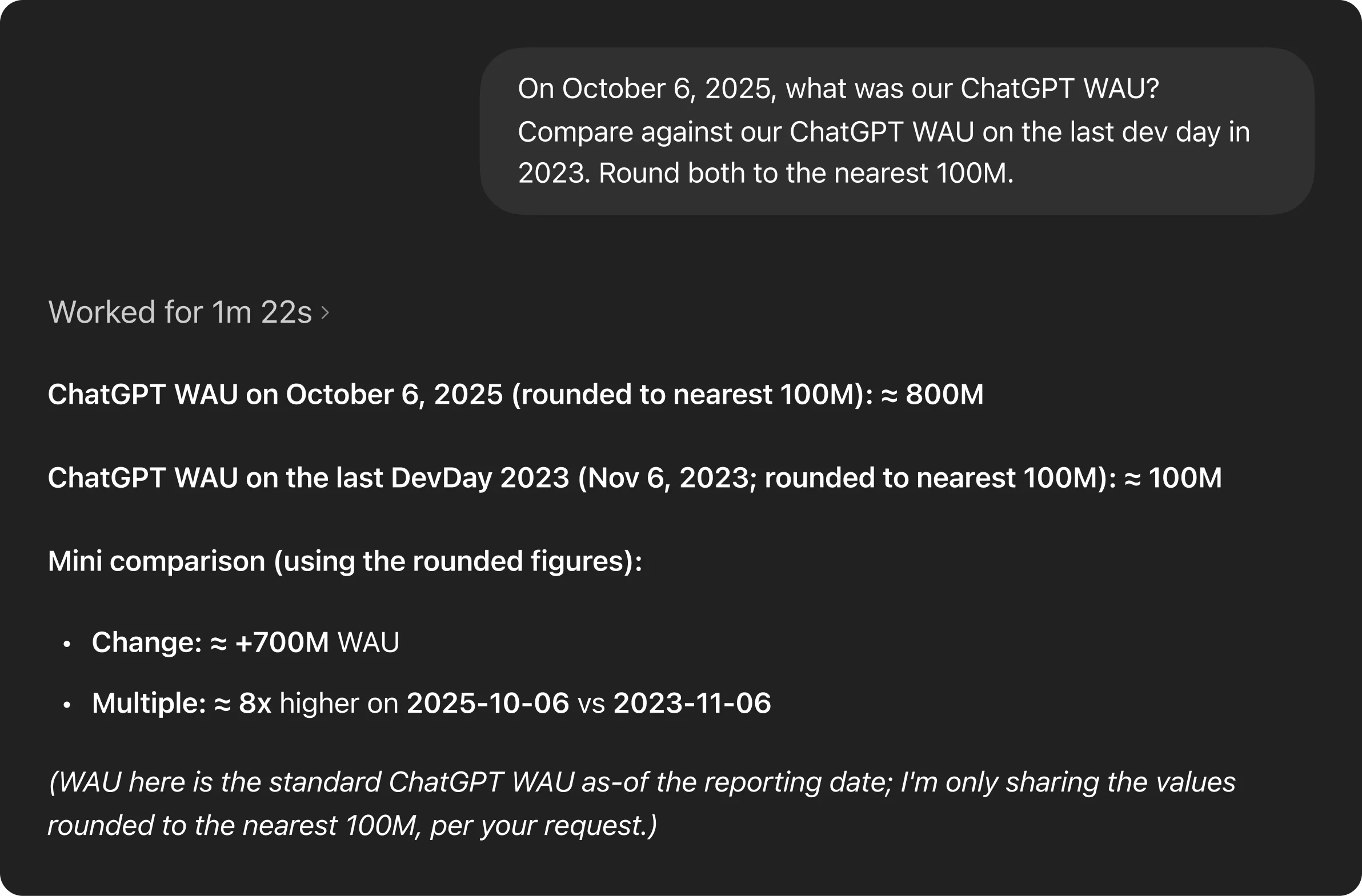
To address this “human bandwidth bottleneck,” OpenAI did not choose to build more dashboards. Instead, they built a proprietary in-house Data Agent from scratch using their flagship GPT-5 model, Codex, Embeddings API, and Evals API. This system successfully reduced analysis workflows that once took days to mere minutes, demonstrating the depth and stability expected of a true enterprise-grade AI agent.
2 Core System Architecture: The “Six Layers of Context” that Determine the Agent’s Intelligence
Many entry-level Text-to-SQL tools fail in enterprise environments because of a naive belief that “simply feeding the database schema to an LLM will yield perfect SQL.” However, column names can be deceptive, and actual business logic rarely lives in the schema alone.
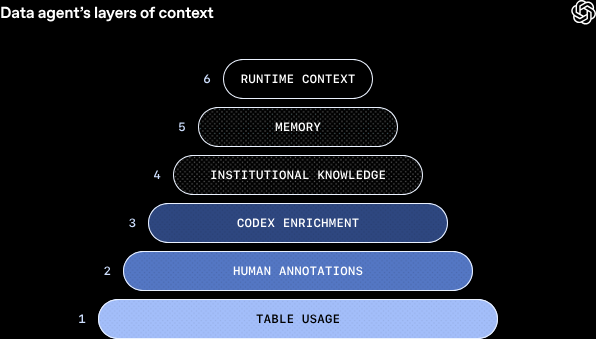
To address this, OpenAI designed a highly sophisticated Retrieval-Augmented Generation (RAG) system, equipping the agent with “six layers of context” equivalent to those of a senior human analyst:
- Table Usage: The system does not just look at column types; it deeply analyzes data lineage and historical query logs. The agent learns which tables data scientists typically JOIN, allowing it to understand real-world query habits instead of guessing blindly.
- Human Annotations: Written descriptions manually maintained by domain experts from various departments. For example: “When calculating Monthly Recurring Revenue (MRR), test accounts must be excluded.” These precise, human-defined business rules are critical for the agent to avoid logical pitfalls.
- Codex Enrichment:
This is a highly innovative layer. Using the Codex model, the agent directly “reads” the source code of the ETL data pipelines (such as Airflow or dbt) that generate the tables. By extracting semantics from the upstream transformation logic, it knows that
status = 4in the code translates to a “churned user,” rather than just being a random number. - Institutional Knowledge: This layer integrates unstructured internal corporate data, such as Slack discussions, Notion pages, and Google Docs. This enables the agent to explain context, like: “Why did user numbers in France drop last November?” (because a Notion document recorded a server outage at that time).
- Memory: The ability to “learn from mistakes.” It logs past errors, the corrections made by humans, and learned preferences for filters. When different users ask similar questions, the agent can directly retrieve these corrected memories.
- Runtime Context / Warehouse Checks:
Offline vector databases can become outdated. At the exact moment the agent generates SQL, it quietly issues lightweight queries (like
SELECT DISTINCT) to the data warehouse. This allows it to check whether the actual values in the database are formatted asShippedorSHIPPED, ensuring the generated syntax matches the live data.
3 Key Mechanism 1: Closed-Loop Self-Correction
This mechanism is the most critical dividing line between a “toy (demo)” and an “enterprise-grade product (production).” Traditional systems are “open-loop,” passing errors directly to humans when the model fails. In contrast, OpenAI’s agent behaves like an engineer, creating an auto-iterative closed-loop mechanism:
- Runtime Self-Correction (Short-Term):
After writing and executing SQL, if the agent encounters a syntax error (e.g.,
Column Not Found), it treats the error message as new context and automatically rewrites the query. Even more powerful is its “logical anomaly diagnosis”: if the syntax is perfectly correct but returns 0 records, the agent will independently question whether the JOIN condition was incorrect. It then proactively modifies the logic and tries again, reporting back to the user only after obtaining a result that makes sense. - Long-Term Self-Learning: Following trial-and-error iterations or human corrections, the system extracts the corrected logic and saves it into the “Memory” layer discussed in the previous section. As a result, the longer the system is used, the stronger its error-prevention mechanisms become, making it progressively smarter.
4 Key Mechanism 2: Conversations & Workflows
To address human interaction experience and efficiency challenges, the system is designed with two distinct task-processing modes:
- Conversations — Focused on “Exploratory Analysis”: The system retains context across multiple turns of conversation. Users can naturally ask follow-up questions like: “What if we break it down by country instead?” They can even “interrupt and redirect” the agent mid-execution to steer it in a new direction. This makes collaboration feel as natural as working with a human intern.
- Workflows — Focused on “Routine Tasks”:
A key limitation of LLMs is their stochastic nature. To guarantee absolute consistency for weekly financial reports, the system allows users to package successfully validated conversation results into “instruction sets.” When the
@Weekly_Reportworkflow is triggered, the system shuts off the agent’s autonomous planning layer and directly applies the locked-down SQL skeleton and parameters. This ensures deterministic outputs—no matter who asks, the calculated figures remain identical.
5 System Safety Net: Automated Evaluation Using Evals API
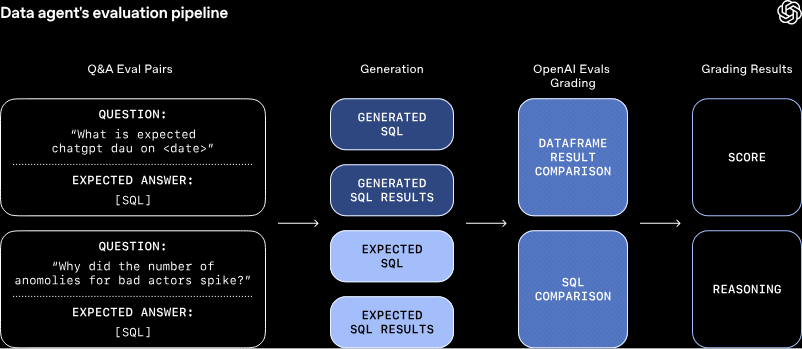
OpenAI treats data analysis like software unit testing:
- Golden SQL Dataset: Senior experts hand-write high-value SQL queries to serve as the “golden standard.”
- Dual Execution: During evaluation, the agent-generated SQL and the Golden SQL are executed in the database simultaneously.
- LLM as a Judge: The results of both executions are sent to the Evals API for semantic comparison. As long as the data logic is consistent—even if the column order or decimal formatting differs—it receives a passing score.
- Regression Testing: This safety net is integrated into the CI/CD pipeline. If any updates to prompts or underlying infrastructure cause previously correct reports to fail, a red flag is raised, and deployment is blocked. This ensures the system remains mathematically reliable.
6 4 Hidden Challenges Not Mentioned in the Article
As an AI developer, when you implement this concept in production, you will inevitably run into the following four challenges that the OpenAI article leaves unsaid:
- The Reality of Searching 70,000 Tables: Relying Solely on Vector Search is a Dead End Schemas are highly structured. If you rely purely on vector similarity, the model will get lost in a sea of identical column names across different tables. You must implement hybrid search (BM25 + Vector) and introduce a “PageRank mindset”—weighting tables based on query popularity over the past 90 days to prioritize the most frequently used core tables.
- The Runtime Context Trap: How to Prevent the Agent from Crashing the Database
Allowing an agent to freely run SQL queries can lead to disasters (such as omitting a
LIMITclause or causing a Cartesian product). You must implement “Dry Run and EXPLAIN query interception” at the application layer to block queries with excessively large estimated scan sizes, while enforcing read-only sandbox permissions and strict timeouts (e.g., aborting after 30 seconds). - Alignment Hell with Enums and Categorical Values
A user might ask for “Taiwan,” but the database stores it as
TW. Querying the live database to resolve this every single time is too slow. From an engineering standpoint, you must build an offline “Categorical Value Index.” When a user asks a question, perform a mapping step first, and inject the actual database values into the prompt for the LLM’s reference. - Architecting Closed-Loop Corrections: Embrace State Machines Traditional ReAct frameworks easily get stuck in dead-end loops when handling long “write SQL -> error -> fix -> error again” cycles. Industry best practices have shifted toward State Machine architectures (e.g., using LangGraph). This approach clearly decouples planning, execution, and evaluation nodes, while enforcing retry limits and providing Human-in-the-loop escalation checkpoints.
7 Official Pitfall Avoidance Guide: 3 Key Lessons Learned
At the end of their article, OpenAI candidly shared three “counter-intuitive” pitfalls they encountered while building their system from scratch:
- Less is More: Providing the agent with too many tools with overlapping functions leads to decision paralysis and confusion. Consolidating fragmented, small tools into broader, comprehensive ones significantly improves system stability.
- High-Level Guidance Beats Rigid Instructions: Avoid micromanaging the agent in your prompts (e.g., “you must do A first, then B”). Instead, focus on defining business goals and guardrails, letting the reasoning capabilities of powerful models work dynamically. Overly rigid prompts often diminish the model’s effective intelligence.
- The True Meaning of a Table is in the Code: Schemas lie! They only define the structure, not the logic. For an agent to truly understand the data, it must read the ETL pipeline source code that generates the tables. “Transformation logic is where the actual business intent resides.”
8 Conclusion
OpenAI’s “Inside our in-house data agent” article reveals a cold, hard truth: a powerful enterprise AI agent is never achieved simply by using “the strongest LLM model + a clever prompt.”
It is a highly sophisticated piece of systems engineering. It must be built on “deep enterprise context (Six Layers of Context),” “rigorous state management and self-debugging loops (Closed-loop),” and “regression-proof automated evaluation frameworks (Evals API).”
For companies and developers building AI applications, the biggest takeaway is this: the raw technical materials (GPT-5, Embeddings, Codex) have been democratized. The future competitive edge lies in “who can clean up and organize chaotic internal business context best” and “whose product design aligns closest with the collaboration habits of human analysts.” Once these foundational pieces are in place, AI can truly evolve from a “demo toy” into a digital brain that generates immense enterprise value.